


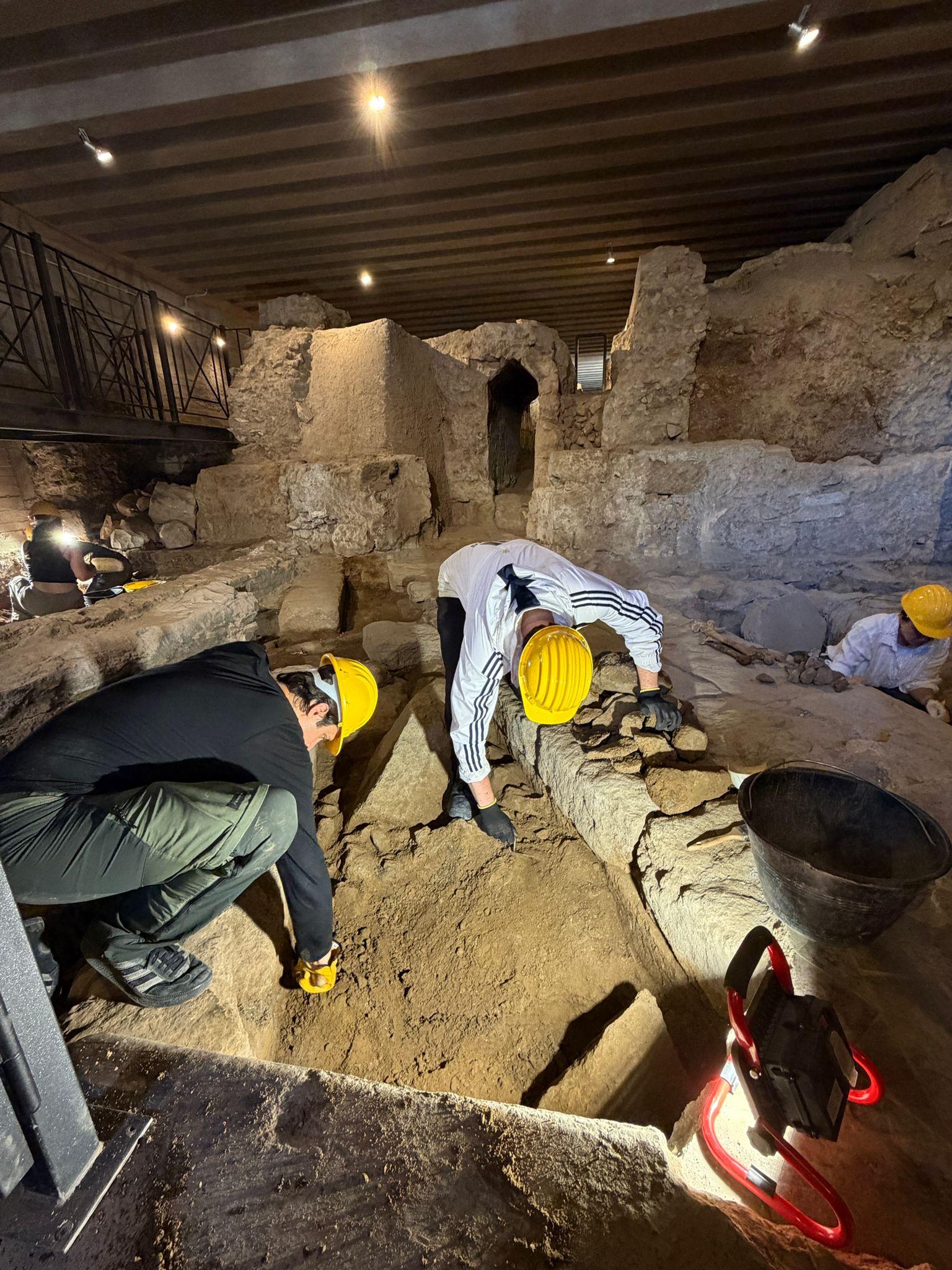
On June 9, the University of Pavia launched its new public archaeology and research campaign in the archaeological area of the Church of Saints Vito and Modesto, in the Esquilino district, near the Arch of Gallienus. The activities will continue through June 26 and will be conducted by a group of Italian and international students and researchers under the direction of Prof. Elena Calandra, a professor in the Department of Humanities at the University of Pavia.
The excavation is being conducted under a concession granted by decree of the Director General of Archaeology, Fine Arts, and Landscape, Dr. Fabrizio Magani, in collaboration with the Special Superintendence for Archaeology, Fine Arts, and Landscape of Rome, directed by Dr. Daniela Porro, in collaboration with the responsible archaeologist, Dr. Fabrizio Santi, and thanks to the hospitality of the Parish of Santa Maria Maggiore in San Vito, represented by Father Simone Pietro Russo.
The excavation campaign is a continuation of the research project launched in 2025 to recover and preserve the documentation and materials from the excavations carried out by the Superintendency in the 1970s. The new investigations aim to reconstruct the area’s complex archaeological stratigraphy through new excavations—the first in more than fifty years—and by employing the most advanced surveying and digital documentation techniques.
Key research topics include the study of the structures attributed to the Servian Walls, the analysis of the associated water infrastructure, and the re-evaluation of certain interpretations made during past excavations, in light of the latest archaeological methodologies.
The San Vito area offers a unique vantage point for understanding Rome’s transformations over the long term: within just a few square meters, it preserves evidence spanning more than two millennia of urban history. The goal is to reinterpret this extraordinary archaeological archive by integrating data from past research with the tools and technologies available today.
Preserving our heritage also involves sharing knowledge; therefore, opening the excavation site to the neighborhood and visitors means involving citizens in the very process of archaeological research, showing how our understanding of the past is built and how this contributes to the preservation of our heritage. This is the very heart of the project: for the entire duration of the campaign, the excavation site will remain open to the public and visitors, who will be able to observe the ongoing activities and engage directly with archaeologists and students in multiple languages. The campaign thus presents itself as a model of integration between scientific research, education, and public archaeology, transforming an important historical site in the Esquilino into an open space for knowledge, participation, and dialogue with the city—from the Protezione Civile Roma Capitale to the Polo Civico Esquilino to companies, such as MIMA s.r.l., which provide valuable support.
A tangible example of this is the partnership between the University of Pavia and the Liceo Classico Pilo Albertelli, led by Prof. Rosa Palmiero: Throughout the year, the University collaborated with the high school—located just a few meters from the excavation site—on a project introducing a fifth-year class to the Esquilino neighborhood, and the high school will even host the students from Pavia for the entire duration of the excavation, demonstrating perfect integration within the public sphere.
INFORMAZIONI
@pavia_at_rome
Campagna di ricerca archeologica dell'Università di Pavia
Area Archeologica della chiesa dei Santi Vito e Modesto
Via Carlo Alberto 47, Roma
Periodo: June 9–26, 2026
Admission: Free admission.
The excavation site will be open to visitors during the research activities; archaeologists and students will be on hand to explain the project to the public in Italian and other languages.